The terms marketing and digital marketing get used interchangeably every day — in agency pitches, in business conversations, in job descriptions — and most of the time nobody stops to clarify what they actually mean.
That ambiguity costs businesses money.
A small business owner who thinks “digital marketing” means “posting on social media” will build an entirely different strategy than one who understands it as a complete system of channels working together to generate leads and revenue. A business that thinks “marketing” is just advertising will miss the customer research, positioning, and experience layers that determine whether campaigns actually work.
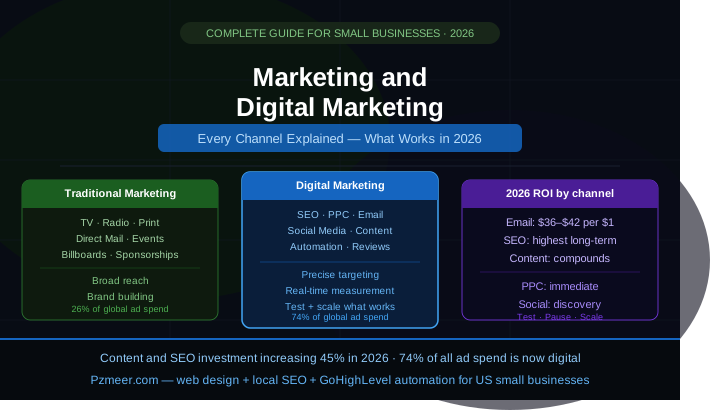
In 2026, digital advertising accounts for over 74% of global ad spend. The real question is not which approach is better — it is how and when to use each effectively.
This guide covers both topics completely — what marketing is at its broadest, what digital marketing includes and how it works, how they relate to each other, which channels deliver the best results for small businesses in 2026, and how to build a strategy that actually generates leads and revenue rather than just activity.
What Is Marketing?
Marketing is the complete process of understanding who your customers are, what they need, how your product or service solves that need, and communicating that solution in a way that causes them to take action.
It encompasses every activity a business uses to attract, engage, and retain customers — both online and offline. The goal of marketing is to create a strong brand presence and drive consumer behavior in ways that lead to desired actions — whether that’s making a purchase, signing up for a newsletter, or sharing word-of-mouth recommendations.
Marketing predates the internet by centuries. A merchant who hung a sign advertising fresh bread in 1850 was practicing marketing. A radio spot for a car dealership in 1955 was marketing. A direct mail catalogue in 1985 was marketing. A sponsored post on LinkedIn in 2026 is marketing.
The medium changes. The underlying logic doesn’t: understand what people want, show them you have it, give them a reason to choose you over an alternative, and make it easy for them to take the next step.
The four traditional pillars of marketing (the 4 Ps):
- Product — what you’re actually selling and how it solves a problem
- Price — what you charge and how that compares to alternatives
- Place — where and how customers find and buy from you
- Promotion — how you communicate your offer to potential customers
Everything in both traditional and digital marketing maps back to these four pillars. The channels are different. The underlying questions are identical.
What Is Traditional Marketing?
Traditional marketing is an approach that relies on offline channels to promote brands, goods, and services. Traditional marketing channels include print, broadcast, event marketing, and physical advertising, and they are used by organisations to reach broad audiences, build trust, and support brand loyalty.
Traditional marketing channels include:
- Television advertising — broad reach, high production cost, difficult to measure precisely
- Radio advertising — local reach, lower cost than TV, strong for local service businesses
- Print advertising — newspapers, magazines, industry trade publications
- Direct mail — physical letters, catalogues, and postcards sent to targeted addresses
- Outdoor advertising — billboards, transit ads, signage
- Event marketing — trade shows, sponsorships, community events
- Word of mouth — the oldest and still one of the most effective channels
Where traditional marketing still works well in 2026:
- Local awareness campaigns for businesses with a geographic footprint (contractors, restaurants, retail)
- Brand-building exercises where reach matters more than precision
- Reaching demographics who are less active online, particularly those over 65
- Trust-building in industries where physical presence signals credibility (finance, healthcare, law)
- Reinforcing digital campaigns with offline touchpoints for stronger recall
Traditional marketing is not disappearing. It is evolving. Streaming is becoming television, print is changing into a digital subscription, and radio has evolved into podcasts.
The honest assessment: for most small businesses with limited budgets in 2026, traditional marketing is less cost-effective than digital because it lacks measurability and targeting precision. You can’t pause a billboard mid-campaign if the offer isn’t converting. You can’t A/B test a radio spot in real time. You pay for the exposure regardless of results.
What Is Digital Marketing?
Digital marketing is a subset of marketing that exclusively utilises online channels to achieve the same objectives. With the rise of the internet and technological advancements, digital marketing has become indispensable in today’s landscape.
Digital marketing is redefining global trade. People do not move through marketing in neat steps. They search, scroll, click, compare, and buy across different platforms, often within the same decision-making moment.
Digital marketing is not one thing — it is a collection of channels and tactics that work together across the online customer journey. Understanding each channel and what it does is the foundation of building an effective digital marketing strategy.
The Core Channels of Digital Marketing in 2026
1. Search Engine Optimisation (SEO)
SEO is the practice of optimising your website and content so it appears prominently when people search for terms relevant to your business on Google and other search engines.
SEO for organic visibility in search engines is one of the most important digital marketing channels because it answers questions when people are actively looking for answers, services, or solutions.
When someone types “web design company near me” or “GoHighLevel pricing” into Google, SEO determines whether your website appears in the results — and where. Ranking on page one for commercial keywords generates consistent, recurring, free traffic without ongoing ad spend once established.
What SEO involves:
- Technical SEO — site speed, mobile-friendliness, crawlability, Core Web Vitals
- On-page SEO — title tags, meta descriptions, heading structure, content quality
- Local SEO — Google Business Profile, local citations, service area pages
- Content SEO — blog posts, guides, and resources that answer the specific questions your customers search
- Link building — earning links from other websites to build your domain authority
SEO is a long-term investment. Results typically take three to six months to materialise and compound over years. For most small businesses, it delivers the highest long-term ROI of any digital marketing channel.
2. Pay-Per-Click Advertising (PPC)
PPC advertising places your ads at the top of search results or across social media platforms — and you pay only when someone clicks. Google Ads and Meta Ads (Facebook and Instagram) are the dominant platforms.
Digital marketing lets you start small, test creatives and audiences, pause what fails, and scale what works — perfect for startups and smaller brands.
Unlike SEO, PPC generates traffic immediately. The trade-off is that traffic stops the moment you stop paying. The most effective digital strategies use PPC for immediate lead generation while SEO builds the long-term organic foundation in parallel.
Types of PPC:
- Google Search Ads — appear when someone searches a specific keyword
- Google Display Ads — banner ads across the Google Display Network
- Google Local Services Ads (LSAs) — pay-per-lead ads for local service businesses with a “Google Guaranteed” badge
- Meta Ads (Facebook and Instagram) — highly targeted ads based on interests, demographics, and behaviour
- LinkedIn Ads — B2B targeting by job title, company, and industry
3. Content Marketing
Content marketing is the practice of creating and publishing valuable, relevant content — blog posts, guides, videos, case studies, podcasts — that attracts and retains a specific audience and, ultimately, drives them toward a business outcome.
Marketers plan to increase investment in content marketing and SEO by 45% in 2026. The shift from traditional to digital isn’t slowing down.
Content marketing works by answering the questions your potential customers are already asking. A web design agency that publishes “How much does a website cost for a small business?” captures that search traffic at the exact moment a prospective client is in the research phase. A GoHighLevel article that explains how to set up automated follow-up sequences captures the search of someone about to buy the platform.
Every piece of content is a permanent asset that continues generating traffic and leads indefinitely once it ranks.
4. Social Media Marketing
Social media marketing focuses specifically on building relationships and visibility through platforms like Instagram, TikTok, Facebook, and LinkedIn. Digital marketing often targets users who already have a need. Social media marketing is driven by discovery — users are scrolling, not searching.
This distinction is critical for strategy. SEO and PPC capture intent — people actively looking for what you offer. Social media creates awareness — interrupting the scroll to introduce your brand to people who weren’t looking but might be interested.
The major social media channels and their primary use cases:
- LinkedIn — B2B lead generation, thought leadership, professional services
- Facebook — local business promotion, community building, older demographics
- Instagram — visual brands, lifestyle products, service businesses with strong visual output
- TikTok — short-form video, discovery marketing, younger demographics
- YouTube — educational content, product demonstrations, long-form video
Social media flips the traditional marketing communication model — platforms enable two-way dialogue, where brands can engage directly, respond in real time, and build genuine relationships at scale.
5. Email Marketing
Email marketing is consistently the highest-ROI digital marketing channel. It is the digital equivalent of direct mail — but faster, cheaper, more measurable, and more personalised.
For every $1 spent on email marketing, the average return is $36–$42 depending on the industry. No other digital channel consistently matches that return.
Email marketing works because your list is an asset you own. Unlike social media followers who are subject to algorithm changes, or search rankings that can shift, your email list is a direct, permanent connection to people who have already expressed interest in your business.
What email marketing includes:
- Broadcast campaigns — newsletters, promotions, announcements sent to your full list
- Automated sequences — pre-built series of emails triggered by actions (a new subscriber, a form submission, a purchase)
- Behavioural triggers — emails sent based on what a contact does or doesn’t do (abandoned cart, opened but didn’t click, hasn’t purchased in 90 days)
- Segmentation — sending different messages to different groups based on their interests, behaviour, or position in the buying journey
6. Reputation Management and Reviews
Local listings — maps and reviews — are a core component of digital marketing for any business with a physical location or service area.
For local businesses — restaurants, contractors, dental practices, law firms, real estate agents — Google reviews are one of the most powerful lead generation tools available. A Google Business Profile with 150 reviews averaging 4.9 stars generates significantly more inbound calls than one with 8 reviews at 3.2 stars, from the exact same position in search results.
Reputation management includes:
- Actively requesting reviews after every transaction or service delivery
- Responding to all reviews — positive and negative
- Monitoring what’s being said about your business across platforms
- Correcting inaccurate information in online directories
7. Marketing Automation and CRM
Customers now assume you will recognise them as they move between search, social media, email, messaging apps, and e-commerce. A strong omnichannel approach keeps messaging consistent across all touchpoints.
Marketing automation is the use of software to automate repetitive marketing tasks — sending follow-up emails, nurturing leads through sequences, triggering SMS messages based on website behaviour, scoring leads based on engagement. It is what turns a website from a digital brochure into a lead generation system.
GoHighLevel, HubSpot, ActiveCampaign, and Mailchimp are the most commonly used platforms for marketing automation. Each has different strengths depending on the size and type of business.
How Marketing and Digital Marketing Relate to Each Other
The simplest way to understand the relationship: digital marketing is the umbrella, and specific channels — social media, SEO, email, PPC — are important elements underneath it. Digital marketing encompasses all online strategies a business uses to reach, engage, and convert customers.
Or to put it another way:
- Marketing is the complete discipline — including all traditional and digital methods
- Digital marketing is the subset of marketing that takes place online
- SEO, PPC, email, social media, content are each specific channels within digital marketing
A complete marketing strategy for a small business in 2026 typically combines:
- Digital marketing as the foundation — because it’s more measurable, more targetable, and more cost-effective at small business scale
- Traditional marketing where it adds value — local awareness, brand reinforcement, specific audience segments
- Systems and automation — connecting the channels so leads captured in one place are nurtured across others
Marketing vs Digital Marketing: The Key Differences
| Dimension | Traditional Marketing | Digital Marketing |
|---|---|---|
|
Primary channels |
TV, radio, print, direct mail, events |
SEO, PPC, email, social media, content |
|
Targeting |
Broad (demographics, geography) |
Precise (behaviour, intent, interests) |
|
Cost |
High upfront, fixed spend |
Flexible, scalable, test-and-learn |
|
Measurability |
Difficult — rough estimates |
Real-time — clicks, conversions, CPA |
|
Speed |
Slow — weeks to months from concept to live |
Fast — campaigns live within hours |
|
Reach |
Local to national, offline audiences |
Global or hyper-local, online audiences |
|
Interaction |
One-way communication |
Two-way conversation and engagement |
|
ROI tracking |
Approximate — correlation studies |
Direct — attribution to specific actions |
|
Testing ability |
Expensive and slow |
Fast and cheap — A/B test anything |
|
Content lifespan |
Short — campaign ends, cost stops |
Long — content assets persist indefinitely |
The Digital Marketing Funnel — How It Works Together
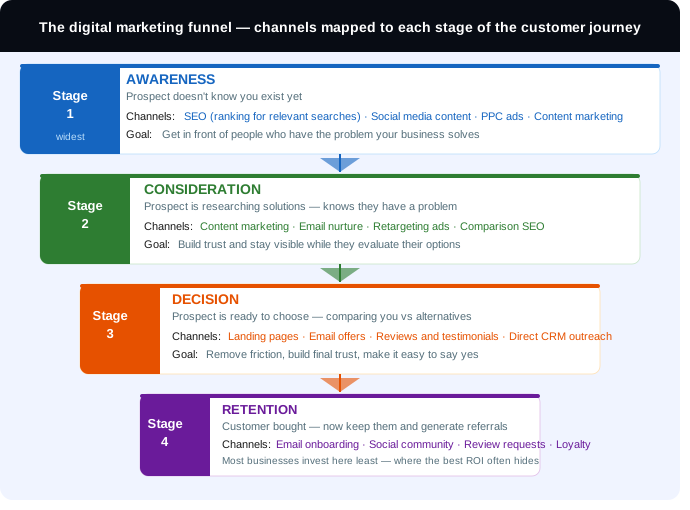
Understanding individual channels is only half the picture. The real power of digital marketing comes from how the channels work together across the customer journey.
Awareness stage — The prospect doesn’t know you exist yet.
- Channels: SEO (ranking for relevant searches), social media (discovery content), PPC (targeted ads), content marketing (informational articles that surface in search)
Consideration stage — The prospect knows they have a problem and is researching solutions.
- Channels: Content marketing (detailed guides that build trust), email (nurture sequences for leads who’ve signed up), retargeting (ads to people who’ve visited your site), SEO (ranking for comparison and review searches)
Decision stage — The prospect is ready to choose between you and an alternative.
- Channels: Landing pages (specific pages designed to convert), email (offers, case studies, urgency), reviews and testimonials (trust at the point of decision), direct outreach via CRM
Retention stage — The customer has purchased and you want to keep them.
- Channels: Email (onboarding sequences, usage tips, check-ins), social media (ongoing community), reputation management (requesting reviews, strengthening the relationship)
Most small businesses invest heavily in awareness and almost nothing in consideration, decision, and retention — which is why their cost per customer remains high. The businesses with the lowest acquisition costs are the ones that convert prospects efficiently across the full funnel.
What Digital Marketing Channels Work Best for Small Businesses in 2026?
The honest answer depends on your business type and timeline. Here’s a practical guide:
For local service businesses (contractors, dentists, restaurants, legal, real estate):
Priority 1: Google Business Profile optimisation and review generation — this is the fastest path to local visibility
Priority 2: Local SEO — service area pages, location-specific content, consistent directory listings
Priority 3: Google Local Services Ads — pay-per-lead ads that appear above organic results
Priority 4: Content marketing — blog posts answering the specific questions your local customers search
Priority 5: Email marketing — nurturing existing customers and past enquiries for repeat and referral business
For agencies and B2B service businesses:
Priority 1: LinkedIn content and thought leadership — the highest-quality B2B lead channel in 2026
Priority 2: SEO targeting decision-maker search queries — “best CRM for agencies,” “web design for law firms”
Priority 3: Content marketing — detailed guides that demonstrate expertise and rank organically
Priority 4: Email marketing — nurture sequences for prospects who have downloaded resources or attended webinars
Priority 5: PPC retargeting — staying visible to people who’ve already engaged with your content
For eCommerce businesses:
Priority 1: Google Shopping and Meta Ads — high-intent buyers at the product research stage
Priority 2: SEO — product and category pages optimised for purchase-intent keywords
Priority 3: Email marketing — cart abandonment, post-purchase sequences, win-back campaigns
Priority 4: Social media — product discovery, user-generated content, influencer partnerships
Priority 5: Review generation — product reviews as trust signals at the decision stage
How Much Should a Small Business Spend on Digital Marketing?
Digital is not always cheaper forever. Some industries are competitive. Costs can climb. Still, you keep control — you can pause spend, shift targeting, or change the message the same day.
A commonly recommended starting point for small businesses is allocating 7–10% of revenue to marketing, with the majority weighted toward digital channels. For a business generating $500,000 in annual revenue, that’s $35,000–$50,000 per year, or $2,900–$4,200 per month across all digital marketing activities.
For businesses just starting digital marketing, a realistic minimum effective budget by channel:
| Channel | Minimum Monthly Budget | What It Gets You |
|---|---|---|
|
Google Ads (PPC) |
$500–$2,000 |
Immediate traffic for high-intent searches |
|
Meta Ads |
$500–$1,500 |
Brand awareness and lead generation |
|
SEO (content + technical) |
$500–$2,000 |
Long-term organic traffic growth |
|
Email marketing (software) |
$30–$200 |
Automated nurture for your list |
|
Social media (organic) |
Time investment only |
Brand presence and community |
|
Marketing automation |
$97–$500 |
Automated lead follow-up (GoHighLevel, HubSpot) |
The most efficient small business digital marketing stack in 2026 combines SEO for long-term organic traffic, Google Ads for immediate high-intent leads, email for nurturing and retention, and marketing automation (GoHighLevel is the platform we recommend for most service businesses) for ensuring no lead slips through without follow-up.
Common Digital Marketing Mistakes Small Businesses Make
Treating channels as isolated tactics instead of a system.
A Facebook ad that drives traffic to a homepage with no follow-up sequence loses most of the leads it generates. Each channel must connect to the next stage of the customer journey.
Measuring activity instead of outcomes.
Follower counts, impressions, and likes are vanity metrics. The only numbers that matter are leads generated, cost per lead, and revenue attributed. Set up conversion tracking before you spend a single dollar on digital marketing.
Starting SEO and expecting immediate results.
SEO takes three to six months to show meaningful results. Starting SEO and abandoning it after eight weeks is the single most common digital marketing mistake small businesses make.
Sending paid traffic to your homepage.
Every paid campaign should go to a dedicated landing page matched to the specific ad’s message. Sending traffic to a general homepage wastes budget — homepage conversion rates on paid traffic are typically under 1%, while matched landing pages convert at 5–10%.
No system for capturing and following up with leads.
A contact form that sits in an email inbox and gets checked twice a week is not a lead capture system. Automated responses within five minutes of a form submission consistently outperform manual follow-up by significant margins.
Publishing content without keyword research.
Content that nobody searches for generates no traffic. Every piece of content should target a specific keyword that your potential customers are actively searching for, validated with keyword research tools before writing begins.
Frequently Asked Questions
What is the difference between marketing and digital marketing?
Is digital marketing replacing traditional marketing?
What are the most effective digital marketing channels in 2026?
No single channel outperforms the others in isolation. Digital marketing channels are most effective when combined within an omnichannel strategy that uses unified data, automation, and AI to support the full customer journey. For most small businesses, the highest-ROI combination is local SEO, Google Business Profile optimisation, email marketing, and marketing automation.
How long does digital marketing take to produce results?
It depends entirely on the channel. PPC produces results within days. Social media builds momentum over weeks to months. Email marketing shows results within the first campaign. SEO typically takes three to six months for meaningful organic rankings and compounds over years. Content marketing compounds the same way as SEO.
Do small businesses need a marketing agency?
Not necessarily. Simple digital marketing — maintaining a Google Business Profile, publishing regular content, managing email marketing — is manageable for a dedicated business owner or in-house team member. Paid advertising, technical SEO, and integrated multi-channel campaigns typically benefit from professional management because the cost of mistakes is high and the learning curve is steep.
What is the ROI on digital marketing?
It varies widely by channel, industry, and execution quality. Email marketing consistently delivers the highest ROI — typically $36–$42 returned per dollar spent. SEO delivers exceptional long-term ROI because the traffic it generates continues indefinitely once rankings are established. PPC delivers immediate, measurable ROI but stops entirely when spend stops.
How Pzmeer Helps Small Businesses With Marketing and Digital Marketing
At Pzmeer, we help US small businesses build the complete digital marketing foundation — starting with a professional, fast-loading website that converts visitors into leads, and extending into the systems that capture and follow up with those leads automatically.
Our services cover the full digital marketing stack for small businesses:
✅ Custom website design — your digital marketing hub, built to convert
✅ Local SEO setup — Google Business Profile, service area pages, schema markup
✅ GoHighLevel setup — automated lead follow-up, CRM, booking, reputation management
✅ Landing page design — for paid traffic campaigns that need dedicated conversion pages
✅ Content strategy guidance — the articles and pages that capture organic search traffic
✅ Email marketing integration — connecting your website to your nurture sequences
We focus on the specific combination that delivers the fastest ROI for most small businesses: a website that ranks and converts, connected to an automation system that ensures no lead goes unfollowed.
👉 Get your free digital marketing consultation at Pzmeer.com — we identify the specific gaps in your current digital marketing and prioritise what to fix first.
Pzmeer is a full-service web design and digital marketing agency helping small businesses across the USA build professional websites, local SEO, and marketing automation systems. Our services include custom web design, WordPress development, GoHighLevel setup, local SEO, and digital marketing strategy.