
When a homeowner’s air conditioning fails in July — or their heat goes out in January — they grab their phone and search. They are not browsing. They are not comparing options at leisure. They need someone now, and the first company that shows up, looks credible, and makes it easy to call or book is the company that gets the job.
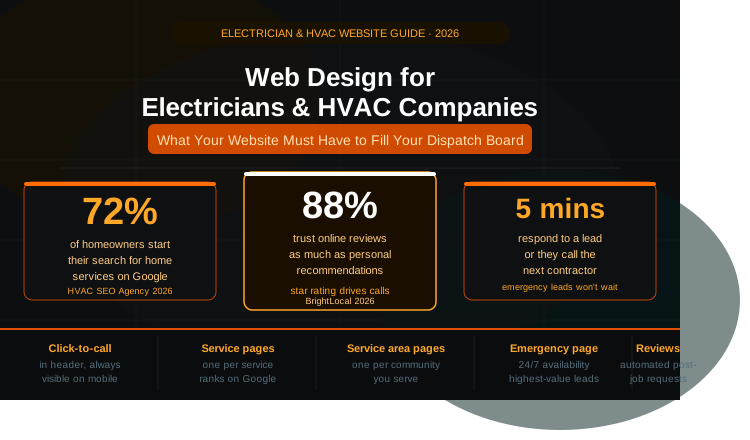
72% of homeowners start their search for home service providers on Google, and 87% of consumers use Google to evaluate local businesses, with 80% of local searches converting to a visit or call.
That is your market. And your website is either capturing it or sending it directly to a competitor.
This guide covers everything an electrician or HVAC company website must have in 2026 to convert that search traffic into booked jobs — the specific pages, the features, the local SEO strategy, the seasonal considerations that most tradespeople miss, and what it realistically costs to get it built right.
Why Electricians and HVAC Companies Are Different From Every Other Business
Before covering what your website needs, it’s worth understanding why the trades are different — and why generic web design advice often fails for contractors.
Your leads are high-urgency and high-intent. A homeowner searching “emergency electrician near me” at 9pm is not casually browsing. They have a problem right now. The conversion window is measured in minutes, not days. Emergency repair leads come primarily through Google searches, and if you don’t pick up, they call the next company. Your website has to make the path from search to call or booking as short as possible.
Your business is seasonal. HVAC is one of the most seasonal industries in home services. If you’re not planning your lead generation around the calendar, you’re leaving money on the table — and starving during slow months. Your website needs to support seasonal campaign shifts — AC tune-up content in spring, emergency repair capture in summer, furnace maintenance in fall, heating repair in winter.
You run two different businesses simultaneously. HVAC companies are essentially running two businesses under one roof: emergency repair (high-urgency, immediate response needed) and replacement or installation (high-margin, longer decision cycle). The same applies to electricians — panel repairs versus new construction wiring or EV charger installation. Your website needs to speak clearly to both audiences with separate conversion paths.
Reviews drive more of your business than almost any other factor. 88% of consumers trust online reviews as much as personal recommendations. A Google rating above 4.7 with 50+ reviews measurably increases click-through rates from both the map pack and organic results. Your website must be built to actively generate and display reviews — not just hope they accumulate passively.
The 10 Must-Have Elements for an Electrician or HVAC Website in 2026
1. Click-to-Call Phone Number at the Very Top
This sounds obvious. You’d be surprised how many contractor websites bury the phone number in the footer.
Your phone number must be:
- Visible in the header on every single page — not just the contact page
- A clickable link on mobile so it dials immediately with one tap
- Formatted clearly with your area code so out-of-state visitors know they’ve found a local business
- Paired with your hours prominently — if you offer 24/7 emergency service, that should be impossible to miss
Emergency customers default to the highest-rated, fastest-responding company. If you don’t answer, they call the next one. The phone number being prominently visible reduces the friction between the decision to call and the call itself.
2. Online Booking System
The online booking widget lets customers see your available time slots and schedule themselves, which is exactly what younger homeowners expect in 2026. No phone tag, no waiting for callbacks.
Not every job is an emergency. Maintenance visits, inspections, and planned installations can be booked in advance — and a significant portion of your potential customers would rather book online at 10pm than call during business hours the next day.
Your booking system should:
- Show real-time availability so customers self-select their preferred slot
- Capture the job type and brief description before confirming — this lets you allocate the right technician
- Send automatic confirmation emails and SMS reminders to reduce no-shows
- Integrate with your CRM or field service management software so bookings appear immediately in your dispatch system
3. Individual Service Pages for Every Core Service
A single “HVAC services” page can’t capture all the different search intents effectively. Emergency repair queries, seasonal tune-up searches, and replacement or installation queries all have different intent profiles and need different pages, different content, and different call-to-action strategies.
Every service you offer should have its own dedicated page. For an HVAC company, that means separate pages for:
- AC repair and emergency cooling service
- AC installation and replacement
- Furnace repair and emergency heating service
- Furnace installation and replacement
- Heat pump installation
- AC tune-up and maintenance
- Heating maintenance
- Duct cleaning and air quality
- Maintenance agreements
For an electrician, separate pages for:
- Electrical panel upgrade and replacement
- EV charger installation
- Generator installation
- Whole-home rewiring
- Emergency electrical repair
- Outlet and switch installation
- Lighting installation
- Home inspection electrical services
Each page targets a specific search query — “AC repair [city],” “electrical panel upgrade [city],” “EV charger installation near me” — and should include a clear description of the service, what the customer can expect, pricing guidance if you publish it, and a prominent call to action to book or call.
4. Service Area Pages
HVAC companies are service area businesses rather than storefront businesses. Your entire SEO approach needs to account for how Google ranks companies that travel to the customer rather than receiving them at a fixed location.
A dedicated page for every city or community in your service area is one of the highest-impact SEO investments a contractor can make. Someone searching “HVAC company in Plano TX” is looking for a local result — a generic “we serve the Dallas area” page won’t rank for that search, but a dedicated Plano page with local content will.
Each service area page should:
- Include the city name and your core services in the page title and H1
- Mention local landmarks, neighborhoods, and geographic details that confirm genuine local knowledge
- Include a map of your service area
- Feature testimonials from customers in that specific area where possible
- Have a unique call to action — don’t just copy the same content across every city page
Aim for one page per major city in your service area. A contractor serving 15 communities should have 15 service area pages. This single content investment consistently outranks competitors who rely on a single “service area” map.
5. Google Reviews — Prominently Displayed, Not Hidden
A Google rating above 4.7 with 50+ reviews measurably increases click-through rates from both the map pack and organic results. BrightLocal’s 2024 Local Consumer Review Survey found that 88% of consumers would use a business that replies to all its reviews, compared to 47% for businesses that don’t respond at all.
Your reviews should appear:
- In the hero section of your homepage — your star rating and total review count visible above the fold
- On individual service pages — testimonials specific to that type of job
- On your contact and booking pages — reassurance at the exact moment someone is deciding whether to call
Beyond displaying reviews, you need a system to consistently generate them. After completing a job, automated systems can send a text asking the customer to leave a review. Since HVAC and electrical buying decisions heavily depend on online reputation, this automation helps build social proof consistently.
The HVAC and electrical companies growing fastest in their local markets are not the ones passively hoping for reviews. They have a systematic, automated request process triggered after every completed job. Contractors using this approach routinely see their review count grow 3–5x within 90 days.
6. Emergency Services Landing Page
If you offer 24/7 emergency service — and most HVAC and electrical companies do — this deserves its own dedicated page.
An effective emergency services page:
- Has an extremely prominent, impossible-to-miss phone number
- Clearly states your 24/7 availability with no ambiguity
- Lists the emergency situations you handle (no heat, no AC, power outage, tripped breaker, sparking outlets, gas smell)
- Includes your fastest estimated response time
- Shows your review rating and count for immediate trust
- Has a short form for customers who prefer to submit a request over calling
This page should also target specific emergency search queries in its title and content: “emergency HVAC repair [city],” “electrician emergency near me,” “no heat [city],” “24-hour electrical service [city].”
Emergency leads are your highest-value leads — high urgency means high conversion when you capture them. A dedicated emergency page that ranks on Google is one of the highest-ROI pages on your entire site.
7. Free Estimate or Free Inspection Offer
Your website forms have a tremendous impact on lead generation rates. A confusing or drawn-out experience can stop potential leads from requesting an estimate or booking an appointment.
A free estimate or free inspection offer — prominently featured on your homepage — is the single most effective lead magnet for trade contractors. Homeowners who are curious about upgrading their electrical panel, replacing their HVAC system, or installing an EV charger will request a free estimate far more readily than they’ll fill out a generic contact form.
The free estimate offer should:
- Appear above the fold on your homepage — not buried in the Services section
- Have its own dedicated landing page for paid traffic
- Require minimal form fields: name, address, email, phone, and job type
- Trigger an automated response within 5 minutes — the lead’s interest is highest immediately after submitting
8. Seasonal Content and Maintenance Agreement Promotion
Maintenance agreements are the most underrated lead generation strategy in HVAC. They do three things at once: generate recurring revenue, keep your techs busy during slow months, and create a built-in upsell pipeline when you find equipment issues during scheduled visits. HVAC companies with strong maintenance programs report that 30–40% of replacement sales come from existing agreement holders.
Your website should actively promote your maintenance agreement programme:
- Dedicated maintenance agreement page explaining the benefits and what’s included
- Clear pricing (annual vs monthly)
- How it saves the customer money compared to paying for individual service calls
- Prominent placement in your navigation and on relevant service pages
Beyond maintenance agreements, your website content should shift with the seasons:
- Spring: AC tune-up content, “prepare your AC for summer” articles
- Summer: Emergency repair capture, same-day service messaging
- Fall: Furnace tune-up, heating maintenance, “is your system ready for winter?” content
- Winter: Emergency heating repair, “furnace not turning on” troubleshooting content
- Year-round: EV charger installation, indoor air quality, energy efficiency upgrades
This seasonal content strategy builds organic search traffic for the queries your customers are actually making at each point in the year.
9. Local SEO — Getting Found When It Matters Most
Local SEO is the single highest-ROI channel for HVAC lead generation over a 12-month horizon. The same is true for electricians. Once you’re ranking in the Google Map Pack for “electrician near me” or “HVAC company [city],” those clicks are free — and they come from customers with the highest possible intent.
Google Business Profile (GBP) is your most important local SEO asset:
- Fully completed with photos of your trucks, team, and completed jobs
- Updated with posts at least once a week during peak season
- Responding to every review — positive and negative — within 24 hours
- Categories set correctly (HVAC contractor, electrician, etc.)
- Services listed with individual pricing ranges where possible
On-site local SEO:
- Title tags following the formula: “[Service] in [City] | [Company Name]”
- Service area pages for every community you serve
- Schema markup so Google understands your business type, service area, and hours
- NAP consistency — your name, address, and phone number must be identical across your website, GBP, and every directory listing
Google Local Services Ads (LSAs): While not strictly a website feature, LSAs deserve mention because they work hand-in-hand with your website. LSAs are Google’s pay-per-lead ad product, sitting above regular Google Ads in search results. You pay only when a homeowner actually calls or messages you. Cost per lead: $25–$50 for most HVAC services. The “Google Guaranteed” badge builds instant trust — homeowners see you’ve been background-checked and verified by Google. Your website serves as the destination for customers who want more information before calling.
10. Professional Truck and Team Photography
Trade contractors underinvest in professional photography almost universally — and it shows in the trust gap between their sites and the competitors winning more jobs online.
Homeowners are inviting you into their homes. Seeing branded trucks, uniformed technicians, and professional team photos before the visit removes uncertainty and builds the trust that converts a browsing visitor into a booked call.
Your photography should include:
- Your branded truck or van in front of a local landmark or neighbourhood setting
- Technicians in uniform on the job — not posed awkwardly, but working naturally
- Before-and-after project photos where applicable (new panel installations, clean ductwork)
- Team photo for your About page
One professional photography session covering all of these typically costs $200–$600 and pays for itself within weeks through improved conversion rates.
The Seasonal Strategy Most Contractors Miss
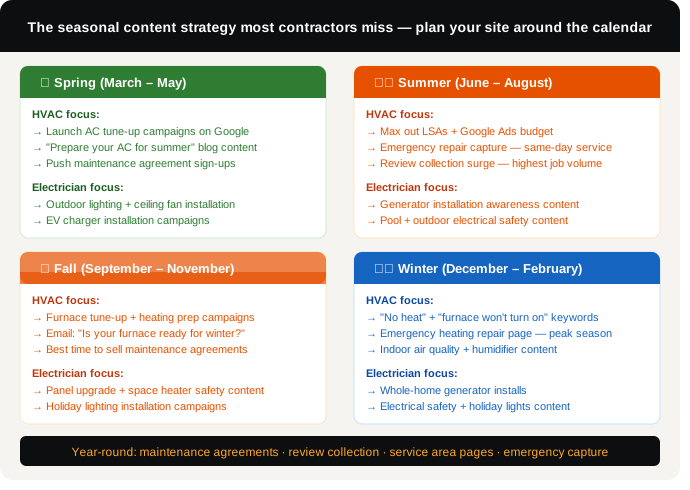
If you’re not planning your lead generation around the calendar, you’re leaving money on the table and starving during slow months. Here is the seasonal strategy that the highest-performing trade contractors use:
Spring (March–May): Launch AC tune-up campaigns. Publish content targeting “AC tune-up cost” and “how to prepare AC for summer.” Push maintenance agreement sign-ups — this is when homeowners are thinking about their cooling system.
Summer (June–August): Emergency repair keywords peak during summer. Make sure your LSAs and Google Ads are maxed out on budget during this period. Focus review generation — high job volume equals high review opportunity if you have an automated request system in place.
Fall (September–November): Shift campaigns to furnace tune-ups, heating system preparation, and heat pump keywords. Email existing customers: “Is your furnace ready for winter?” This is the best time to sell maintenance agreements to customers who just got through summer.
Winter (December–February): Emergency heating keywords stay active — “no heat,” “furnace won’t turn on.” The first cold snap of the season drives a surge of emergency searches. For electricians, indoor heating upgrades, whole-home generators, and holiday lighting installation searches peak.
What Does an Electrician or HVAC Website Cost in 2026?
| Website Type | Cost Range | Best For |
|---|---|---|
|
DIY template (Wix, GoDaddy) |
$20–$50/month |
Brand new business, very tight budget |
|
Basic professional template |
$500–$2,000 |
Small solo contractor needing online presence |
|
Custom WordPress contractor site |
$1,500–$5,000 |
Growing contractor serious about leads |
|
Full custom with booking integration |
$3,000–$8,000 |
Established business running paid traffic |
|
Multi-location with CRM integration |
$5,000–$15,000 |
Regional contractor or franchise |
What typically makes the most sense for most contractors:
custom WordPress tier — $1,500 to $5,000 — delivers individual service pages, service area pages, online booking, Google reviews integration, local SEO setup, emergency service landing page, mobile optimisation, and everything else covered in this guide. That range delivers the features that actually generate leads, at a price that makes sense for an independent contractor.
Additional monthly costs to budget:
- Hosting: $30–$100/month
- Google Local Services Ads: $500–$2,000/month depending on market
- SEO management: $500–$2,000/month if outsourced
- Review management software: $50–$150/month
Why Pzmeer offers outstanding value for US trade contractors:
At Pzmeer, we build professional, lead-generating contractor websites at 40–60% less than US-based agencies — without cutting corners on the features that actually matter for your industry. Every project includes custom design, individual service pages, service area pages, online booking integration, Google reviews display, local SEO setup, mobile optimisation, SSL, domain configuration, and Google Search Console submission as standard.
Common Mistakes That Kill Contractor Website Conversions
No phone number visible above the fold. The most common mistake on contractor websites. Your phone number should be in the header, on every page, clickable on mobile.
One generic services page. A single “Services” page listing everything you do cannot rank for any individual service query. Every service needs its own page.
No emergency services page. If you offer 24/7 service, this deserves prominent, prominent treatment — not a bullet point buried in your FAQ.
Hiding the free estimate offer. Your estimate CTA should be above the fold on your homepage. Not in the footer. Not only on the Contact page.
No system for generating reviews. The average HVAC lead costs $30–$150 depending on the channel and market — yet reviews that influence the decision to call cost almost nothing to generate if you have an automated request system in place. Most contractors have no system at all.
Sending paid traffic to the homepage. Any Google Ads or LSA traffic should go to a dedicated landing page for that specific service — AC repair, panel upgrade, furnace replacement — matched to the ad’s message. Sending it to your homepage wastes your ad spend.
Slow mobile load speed. Over 70% of contractor searches happen on mobile. A page that takes more than 3 seconds to load loses half its potential visitors before they ever see your phone number.
No seasonal content. A website with the same content in January and July is leaving significant organic search traffic uncaptured during your two highest-opportunity seasons.
Frequently Asked Questions
Does my electrical or HVAC company really need a website if I get most business through referrals?
Yes — and urgently so. Referrals typically look you up online before calling. 88% of consumers trust online reviews as much as personal recommendations, and a poor website or no website can kill a referral lead that would otherwise have converted automatically. Additionally, referrals alone rarely scale past a certain point — organic search traffic is the only way to grow your lead volume without proportionally growing your marketing spend.
What is a Google Local Services Ad and should I use one?
LSAs are Google’s pay-per-lead product sitting above regular Google Ads. You pay only when a homeowner calls or messages you — not per click. They carry a “Google Guaranteed” badge and typically cost $25–$50 per lead for HVAC services. For most trade contractors, LSAs are the fastest path to qualified leads and work best when your website is properly built to provide more information to leads who want to research before calling.
How many pages should my contractor website have?
At minimum: a homepage, individual pages for each core service (aim for 6–10), individual service area pages for each community you serve (aim for 8–15), an emergency services page, an about page, a contact and booking page, and a blog or resources section for seasonal content. A well-built contractor site typically has 30–50 pages once service and area pages are fully developed.
How do I get my HVAC or electrical company to rank on Google Maps?
Claim and fully complete your Google Business Profile. Add photos regularly. Respond to every review. Keep your business information consistent across all directories — same name, address, and phone number everywhere. Build service area pages on your website. Get listed on relevant directories (Angi, Houzz, Yelp, Nextdoor Business, BBB). Collect reviews consistently through an automated post-job request system. This combination, applied consistently over 3–6 months, drives Map Pack rankings for most trade contractors in mid-sized markets.
Should I show pricing on my website?
For standard services with predictable costs — AC tune-up, electrical inspection, panel replacement starting price — showing at least a range on your website improves conversion rate by removing uncertainty. For custom jobs where price varies widely based on site conditions, offering a free estimate is more appropriate than trying to publish a price range.
How important is mobile optimisation for a contractor website?
Critical. When someone’s HVAC breaks or they need an emergency electrician, they grab their phone and search. More than 70% of contractor searches happen on mobile, and the entire journey from search to call often happens within minutes on a small screen. Every element of your site — phone number, booking form, emergency CTA — must work instantly and intuitively on mobile.
Build a Contractor Website That Fills Your Dispatch Board
Your website is your most consistent, lowest-cost lead source once it’s properly built and ranking. Unlike paid lead platforms where you compete on price and lose margin to third-party commissions, organic traffic from your own website delivers leads that are exclusively yours — at no per-lead cost once you’re ranking.