
If you own a restaurant in the USA and your website is slow, outdated, or doesn’t have online ordering — you are losing customers every single day to the restaurant down the street that does.
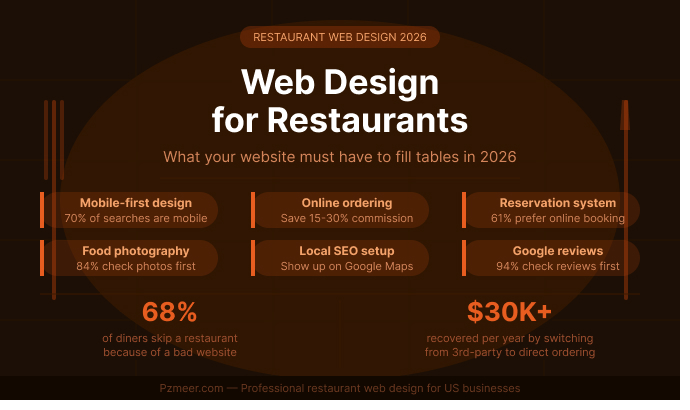
Here’s the number that should get your attention: <strong>68% of diners say a poor website has discouraged them from visiting a restaurant.</strong> Not a bad review. Not a bad location. A bad website.
Your website is your digital front door. Before a customer decides to drive to your restaurant, book a table, or order takeout — they visit your website first. What they see in those first five seconds determines whether they stay or leave.
This guide covers every element your restaurant website must have in 2026 — the features that actually drive reservations, online orders, and walk-ins. Plus, what it should cost and how to get it built properly without overspending.
Why Your Restaurant Website Matters More Than Ever in 2026
The restaurant industry has changed dramatically. <strong>Over 70% of restaurant searches in 2026 now come from mobile devices.</strong> Customers are searching “best Italian restaurant near me” or “pizza delivery open now” — and they’re making decisions within seconds of landing on a website.
Here is what diners are doing before they visit or order:
- Checking your menu online before deciding
- Looking at food photos to decide if they want your cuisine
- Searching for your hours and location
- Looking for online ordering or reservation options
- Reading your Google reviews
<strong>84% of US restaurant guests look at menu photos online before ordering.</strong> If your photos are blurry, missing, or non-existent — they are choosing someone else.
Social media alone is not enough. Instagram and Facebook are rented platforms — the algorithm changes, business accounts get suppressed, and you can lose access without warning. Your website is the one online asset you fully own. It is your most important marketing tool.
The 10 Must-Have Elements for a Restaurant Website in 2026
1. Mobile-First Design That Loads in Under 3 Seconds
This is not optional. <strong>62% of global internet traffic comes from mobile devices</strong>, and Google ranks your website based on its mobile version — not the desktop version. If your site looks great on a laptop but is clunky on a phone, Google penalizes your rankings and customers leave.
What mobile-first means for your restaurant:
- Text is readable without zooming
- Buttons are large enough to tap with a thumb
- Your menu scrolls smoothly without pinching
- The “Order Now” or “Reserve a Table” button is visible immediately on the phone screen
- Pages load in under 3 seconds on a mobile connection
<strong>Every second of extra load time costs you customers.</strong> A page that takes 5 seconds to load loses 40% of visitors before they even see your menu.
2. Your Full Menu — Displayed Properly (Not as a PDF)
Your menu is the single most important page on your restaurant website. It is the primary reason most visitors come to your site. And yet, the most common mistake restaurants make is uploading their menu as a PDF.
<strong>Never use a PDF menu.</strong> Here is why:
- PDF menus are not mobile-friendly — customers have to pinch and zoom
- They cannot be indexed by Google — so you lose SEO value from your menu items
- They cannot be updated easily — your menu shows stale prices and dishes
- They do not convert visitors into orders — they create friction instead
Your menu should be displayed as a proper HTML web page with:
- Dish names and descriptions written out fully
- Current prices clearly visible
- High-quality photos of your signature dishes
- Easy navigation between categories (starters, mains, desserts, drinks)
- Regular updates when items change seasonally
<strong>Pro tip:</strong> Include the names of your most popular or unique dishes in your menu page text. When someone in your city searches “best wood-fired pizza in [city]” — your menu page can rank for that search if it is built correctly.
3. Online Ordering System — Directly on Your Site
<strong>Restaurants that shift just 20% of their orders from third-party platforms to direct ordering can recover $30,000–$100,000 per year in commission savings.</strong>
DoorDash, Uber Eats, and Grubhub charge 15–30% commission on every order. On a $50 order, that is $7.50–$15 going directly to the platform — not to you.
A direct online ordering system built into your website means:
- You keep 100% of the revenue (minus payment processing fees of 1.5–3.5%)
- You own the customer data — email, phone, order history
- You can run loyalty programs and promotions directly
- Your brand is front and center, not buried inside an app
You can still list your restaurant on third-party apps for discovery — but your website should always offer direct ordering with an incentive. Something as simple as “Order direct and save 10%” drives customers to your own channel.
4. Online Reservation System
<strong>61% of diners are more likely to make a reservation at a restaurant that offers online booking than one that doesn’t.</strong>
Calling a restaurant to make a reservation is becoming a thing of the past — especially for customers under 40. They want to book a table the same way they book a hotel or a flight: online, instantly, at 11pm when they’re making plans.
Your reservation system should:
- Allow customers to select date, time, and party size
- Send automatic confirmation emails and SMS reminders
- Allow easy cancellation or rescheduling without calling
- Reduce no-shows with automated reminder messages
- Integrate with your calendar so you never double-book
Tools like OpenTable, Resy, and SevenRooms integrate directly into your website and handle the entire reservation process automatically.
5. Professional Food Photography
Food is emotional. A beautifully photographed dish creates desire before a single bite is taken. <strong>Websites with high-quality food photography see significantly higher conversion rates</strong> compared to those with generic stock photos or phone snapshots.
Your photography should include:
- Hero images — large, beautiful shots of 3–5 signature dishes for the homepage
- Menu photos — at least your most popular dishes on every category
- Atmosphere shots — the dining room, bar area, outdoor seating
- Team photos — your chef, your staff, the story behind the food
You do not need to hire an expensive professional photographer for every shoot. Many restaurants do a single well-planned photography session covering 20–30 dishes and use those images across their website, social media, and marketing materials.
<strong>One investment in great food photography pays dividends for 2–3 years.</strong>
6. Your Location, Hours, and Contact Information — Always Visible
This sounds obvious. You would be shocked how many restaurant websites make customers dig three pages deep to find the address or phone number.
Every page of your website — especially the homepage — should display:
- Your full street address with a Google Maps embed
- Current opening hours (including holiday variations)
- Phone number as a clickable link on mobile (tap to call)
- Email address for catering or event inquiries
- Parking information if relevant
Your address and hours need to match exactly what is listed on your Google Business Profile and across every other online directory. Inconsistent information confuses Google and hurts your local search rankings.
7. Google Reviews Integration and Social Proof
<strong>94% of diners say online reviews influence where they eat.</strong> Your website should make your reviews impossible to miss.
What to include:
- A dedicated section on your homepage showcasing your best Google and Yelp reviews
- Your overall star rating displayed prominently
- A direct link to “Leave us a review on Google”
- Any press coverage, awards, or media features displayed as logos
Automating review requests is the fastest way to grow your review count. After every dining experience, an automated system can send a text message or email asking for a review. Restaurants using this approach consistently see their Google review count grow 3–5x within 90 days.
8. Your Story — The About Page That Actually Connects
People do not just choose a restaurant for the food. They choose it for the feeling. The story. The connection to the people behind the kitchen.
Your About page should answer:
- Who started this restaurant and why?
- What makes your food different from every other restaurant in the area?
- Where do your ingredients come from? Local farms? Family recipes?
- What is the dining experience like?
A well-written About page creates emotional connection before the customer walks through the door. It is also an important SEO page — use the name of your city, your cuisine type, and your restaurant’s unique angle throughout the copy.
9. Local SEO — Getting Found on Google Maps
Having a beautiful website is only half the battle. It needs to be found.
<strong>Local SEO for restaurants means showing up when someone in your city searches for your type of food.</strong> Here is what drives local restaurant SEO in 2026:
Google Business Profile: Your Google Business Profile is the single most important local SEO asset you have. It is what shows your restaurant in Google Maps and the local pack (the three businesses that appear in a box at the top of Google results). Make sure yours is:
- Fully completed with photos, hours, menu, and description
- Consistently updated with posts and new photos
- Responding to every review — positive and negative
On-page local SEO:
- Include your city name naturally throughout your website copy
- Create location-specific page titles: “Italian Restaurant in [City Name]”
- Add schema markup (structured data) so Google understands your business type, hours, menu, and location
- Build a dedicated FAQ section — this helps you appear in Google’s AI Overviews and voice search results
Voice search optimization: <strong>27% of restaurant searches are now voice-based</strong> — people asking Google or Siri “best sushi restaurant near me open now.” Your website should include conversational language that matches how people speak naturally, not just how they type.
10. Gift Cards, Loyalty Program, and Email Capture
These three features separate restaurants that survive from restaurants that thrive.
Gift cards sold online are one of the most profitable revenue streams a restaurant can add. The customer pays upfront, often buys a higher amount than they will spend, and brings new guests with them when they redeem.
A loyalty program — even a simple one — gives customers a reason to choose you over the competitor next door. A digital stamp card or points system integrated into your website keeps customers coming back.
Email capture is the most valuable long-term marketing asset you can build. A list of 1,000 customers who have opted in to hear from you is worth more than 10,000 Instagram followers you do not own. Offer a discount or a free appetizer in exchange for an email sign-up, and you build a direct marketing channel that no algorithm can suppress.
What Does a Restaurant Website Cost in 2026?
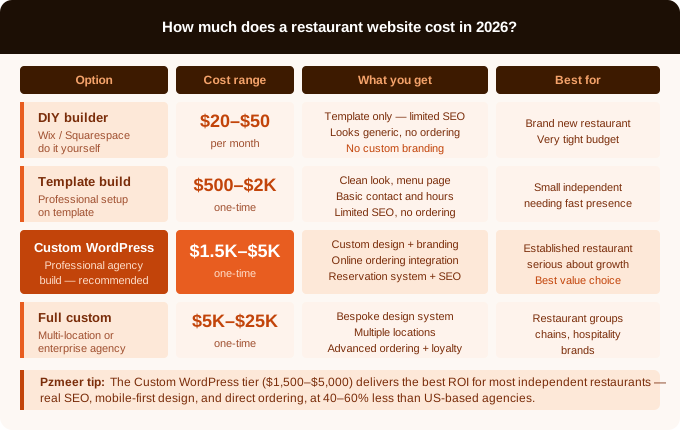
Basic restaurant websites in 2026 typically land between $500 and $3,000 — usually template-based or DIY-assisted. But for most serious restaurant owners who want real results, here is the real breakdown:
| Website Type | Cost Range | Best For |
|---|---|---|
|
DIY (Squarespace, Wix) |
$20–$50/month |
Brand new restaurant, very tight budget |
|
Template-based professional build |
$500–$2,000 |
Small independent restaurant needing a clean presence fast |
|
Custom WordPress restaurant site |
$1,500–$5,000 |
Established restaurant wanting SEO, online ordering, and reservations |
|
Full custom design with ordering system |
$5,000–$15,000 |
Multi-location or restaurant serious about growth |
A small independent restaurant should budget $1,500 to $5,000 for a professional website with online ordering and reservation capabilities — this range delivers the features that actually drive revenue.
Additional monthly costs to factor in include hosting ($20–$200/month), SEO management ($300–$2,000/month), and maintenance ($100–$500/month).
Why offshore agencies like Pzmeer offer significant value: A restaurant website that would cost $5,000–$10,000 at a US-based agency can often be built at 40–60% lower cost by a professional offshore agency like Pzmeer — without sacrificing quality. Every Pzmeer project includes custom design, domain registration, SSL, WordPress setup, mobile optimization, and Google Search Console submission as standard. No hidden fees.
Common Restaurant Website Mistakes to Avoid
Using a PDF menu. We covered this — but it is the single most damaging mistake restaurant owners make online. Fix it today.
No mobile optimization. If your website is not optimized for mobile, you are invisible to the majority of your potential customers.
No online ordering. Every week you don’t offer direct online ordering, you are paying 15–30% commission to third-party platforms unnecessarily.
Outdated hours or closed location still online. Nothing destroys trust faster than a customer driving to your restaurant based on your website hours — only to find it closed.
Slow loading photos. Beautiful food photography uploaded at full resolution will destroy your page load speed. Always compress images before uploading.
No call to action on the homepage. Your homepage needs one clear action above the fold — “Order Online,” “Book a Table,” or “View Menu.” Not all three. One clear button that tells the visitor what to do next.
Not responding to Google reviews. <strong>75% of consumers say they judge a business’s credibility based on its website and online presence.</strong> Ignoring reviews — especially negative ones — signals that you do not care about your customers.
How Long Does a Restaurant Website Take to Build?
Timeline depends on complexity:
| Website Type | Build Time |
|---|---|
|
Template-based simple site |
1–2 weeks |
|
Custom WordPress restaurant site |
3–5 weeks |
|
Full custom with online ordering and reservations |
5–8 weeks |
The main thing that delays restaurant website projects is missing content — specifically, not having menu copy, food photography, and the brand story ready before the project starts. The more prepared you are, the faster your site goes live.
Frequently Asked Questions
Yes — absolutely. Social media platforms change their algorithms constantly, suppress business pages, and can suspend your account without warning. You do not own your social media presence. Your website is the only digital asset you fully control. It also ranks on Google, which social media pages do not do well.
Your menu page. It is the primary reason most visitors come to your site. It needs to be mobile-friendly, updated regularly, and never a PDF.
Accordion ConaClaim and fully complete your Google Business Profile at business.google.com. Add photos, set your hours, list your menu, and ask every customer to leave a Google review. This is the most impactful thing you can do for local search visibility.tent
These platforms work for brand-new restaurants on very tight budgets. However, they have significant SEO limitations, look templated, and lack the flexibility to add proper online ordering and reservation systems as your business grows. A professional WordPress site built by an agency offers far better long-term value.
Build a direct online ordering system into your website and promote it with an incentive — “Order direct, save 10%.” Email your existing customer list. Add a QR code on your tables and physical menus that links directly to your online ordering page.
Yes — if it is built on WordPress, you can update your menu, photos, hours, and news posts yourself without needing a developer. This is one reason WordPress is the preferred platform for restaurant websites.
Update your menu every time your offerings change. Update your photos at least once per season. Post a blog or news update monthly to keep your site fresh for Google.
Get Your Restaurant Website Built by Pzmeer
Your restaurant website is your most important marketing asset. It works 24 hours a day, 7 days a week, turning online searches into tables booked and orders placed.
At Pzmeer.com, we build professional, custom restaurant websites for US restaurant owners at prices that make sense. Every project includes:
- Custom design built around your brand and cuisine
- Mobile-first, fast-loading WordPress build
- Menu displayed properly — never a PDF
- Online reservation integration
- Google Maps and contact integration
- Local SEO setup from day one
- Google Search Console submission
- SSL, domain, and hosting configuration
- Social media banner design included
All at 40–60% less than a US-based agency would charge for the same scope of work.
👉 Get your free restaurant website quote at Pzmeer.com — we respond within 24 hours.
Pzmeer is a full-service web design agency helping restaurants and small businesses across the USA build professional websites that drive real results. Our services include custom web design, WordPress development, local SEO, and digital marketing.