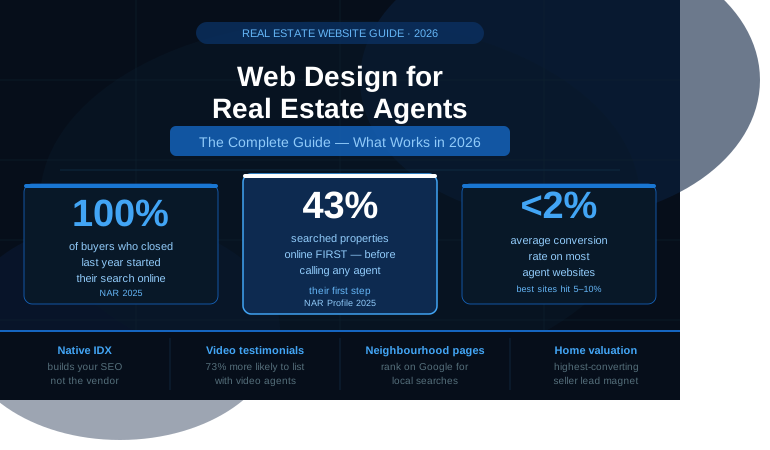
Every single home buyer who closed on a house last year started their search online. Not most of them. Not a large majority. One hundred percent of them, according to the NAR 2025 Profile of Home Buyers and Sellers. And 43% say their very first step was to search for properties online — before they spoke to a lender, picked a neighborhood, or called an agent.
Your website is not a supplementary marketing tool. It is where your business begins.
The gap between a real estate website that generates consistent leads and one that generates nothing is rarely about the market. It’s about the website. The average real estate agent website has a conversion rate of less than 2% — meaning for every 100 visitors, fewer than 2 people take any meaningful action. The best-built agent sites convert at 5–10% or more, from the same traffic.
This guide covers every element a real estate agent website needs to work in 2026 — IDX integration, lead capture, local SEO, what to include on every key page, what it costs, and the mistakes that quietly kill conversions on most agent sites.
Why Most Real Estate Agent Websites Fail
Before covering what your website needs, it’s worth understanding why most agent websites fail even when they look professional at first glance.
Every single home buyer who closed on a house last year started online, and 43% of them say their very first step was to look for properties online before they talked to a lender, picked a neighborhood, or called an agent. Yet most agent websites fail to capture a single lead in a quarter.
The most common reasons:
Relying on the brokerage website. Your leads, your SEO, and your brand equity all live on someone else’s domain. When you switch firms, all of it evaporates. Every lead you captured, every search ranking you built — gone with your next brokerage move.
No property search on the site. A website without IDX integration forces visitors to go to Zillow or Realtor.com to search listings. You are paying for a site that drives traffic directly to your competitors.
Slow load times. If your website takes longer than 3 seconds to load, you’ve already lost 57% of potential visitors. Most agent websites are bloated with unnecessary plugins, oversized images, and poor hosting.
Generic design with no clear message. A website that looks like every other agent’s website — same stock photo, same headline, same layout — gives visitors no reason to choose you over the next result in Google.
No follow-up system connected to the site. Leads that arrive and don’t get an immediate, automated response within minutes are leads you will almost certainly lose to a competitor who does respond quickly.
The Most Important Feature: IDX Integration
IDX/MLS integration is the single most important feature for most agents. Without live listing search on your own domain, your website can’t compete with major portals for buyer engagement, and you miss the SEO authority that native IDX integration builds over time.
IDX — Internet Data Exchange — is the system that allows you to display live MLS listings directly on your own website. When a buyer searches properties on your site instead of Zillow, two things happen that change your entire business model:
You capture their contact information. When a visitor saves a search, sets up listing alerts, or registers to view full listing details, they give you their name, email, and often phone number — directly into your database. On Zillow, that same visitor generates a lead that Zillow sells to the highest bidding agent. On your IDX site, it’s your lead.
You capture their behavioral data. The most valuable thing your IDX site produces isn’t contact information — it’s behavioral context. What a lead searches, how often they return, what price ranges and neighborhoods they focus on — this data should inform how you follow up.
Native IDX vs. iFrame IDX — The SEO Difference Nobody Explains Clearly
Confirm whether listings are served from your own domain (native IDX) or a vendor’s domain (iFrame IDX). The difference has a direct impact on your SEO — iFrame IDX generates zero domain authority for your site, meaning every listing page your visitors browse builds search equity for the vendor, not you.
Most template-based real estate sites use iFrame IDX because it’s cheaper and simpler to implement. The problem: every property page your visitors browse is actually hosted on the IDX vendor’s domain. Google sees those pages as belonging to the vendor, not to you. You get none of the SEO value. A native IDX integration — where listings are indexed on your actual domain — builds your domain authority with every single listing page over time.
What Modern IDX Must Include
Modern IDX platforms that convert visitors well include map-based property discovery, advanced filtering capabilities, visual property comparisons, real-time market data, saved search functionality, and property alert systems.
The map search feature in particular is worth emphasizing. Buyers in 2026 think geographically first. They want to see properties on a map, understand proximity to schools and work, and explore neighborhoods visually. A list-only IDX search feels outdated next to what Zillow provides. Map-based search keeps visitors engaged 4–5 times longer than list views — and session duration is a direct SEO signal.
The 10 Must-Have Elements for a Real Estate Agent Website in 2026
1. Mobile-First Design That Loads Fast
Property search happens predominantly on mobile devices — over 60% of all property searches are conducted on a mobile device. Google uses mobile-first indexing, meaning your mobile site is what determines your search rankings, not your desktop version.
Every element of your site must work flawlessly on a phone — property search filters, map navigation, photo galleries, contact forms, and your booking calendar. IDX websites typically show 400% longer session times than static agent sites — but only if the mobile experience is smooth enough to keep visitors engaged.
2. A Professional About Page That Builds Trust Immediately
Your About page is typically the second most-visited page on a real estate website after the listing search. Buyers and sellers want to know who they’re dealing with before they reach out — a well-written About page with a professional photo, specific market experience, and detailed descriptions of who you help and how can meaningfully increase the conversion rate of visitors to contacts.
Your About page should include:
- A professional headshot — not a glamour shot, not a phone photo. A real, well-lit professional photo.
- Your market specialisation — what neighbourhoods, price ranges, and buyer/seller types you primarily serve
- Specific results — not “I’m dedicated to my clients” but “I’ve helped 47 families buy their first home in the Dallas-Fort Worth area since 2019”
- Your personal connection to the market — why you work in this area, what you know about it that someone new to the business couldn’t know
- Client testimonials specific to the experience of working with you, not just “great agent”
3. Home Valuation Tool for Seller Lead Capture
A free home valuation offer is consistently the highest-converting lead magnet available to real estate agents. Sellers actively looking to list their home will exchange their contact information for a rough valuation estimate far more readily than they’ll fill out a generic contact form.
Your home valuation tool should:
- Be prominently featured on your homepage — not buried in a menu
- Ask for only the minimum information needed (address, name, email, phone)
- Trigger an automated follow-up immediately — the seller’s interest is highest in the first 5 minutes after they submit
- Feed directly into your CRM so the lead is visible and actionable instantly
4. Neighbourhood and Community Pages
The essential features for real estate website SEO include neighbourhood pages with locally relevant content. These pages do two things simultaneously: they help you rank on Google for location-specific searches, and they demonstrate genuine local knowledge to visitors who are evaluating whether you know their area.
A strong neighbourhood page for a real estate agent includes:
- Current market statistics for that specific area (median sale price, days on market, price trends)
- School information with ratings and links to school district data
- Local amenities — restaurants, parks, transit, community features
- Current listings in that neighbourhood embedded via your IDX
- Your personal experience with the area — what you know from working there
One neighbourhood page per major area you serve is a minimum. Agents with 15–20 detailed neighbourhood pages consistently outrank agents with no location-specific content on Google for searches like “homes for sale in [neighbourhood]” or “real estate agent in [area].”
5. Client Testimonials and Video Testimonials
73% of home owners are more likely to list with a real estate agent who uses video to sell property. Videos drive 403% more inquiries from listings. Yet only 10% of real estate agents effectively use video to market their property.
The agents who understand this — and use video testimonials specifically — are operating with a significant trust advantage over the 90% who don’t.
A written testimonial builds credibility. A video testimonial — 60–90 seconds of a real client talking about what it was like to work with you — builds it far more powerfully, because it removes any suspicion that the testimonial was edited or embellished. Real people speaking naturally about their experience is the most authentic form of social proof available.
Aim for at least 3 video testimonials on your homepage. If you’ve never asked clients to record a short video, this is the highest-ROI request you can make of your past clients right now.
6. A Clear Home Page Structure That Converts
Your homepage has one job: move a visitor from “I just found this agent online” to “I want to talk to this agent.” Every element should support that transition.
A converting real estate homepage in 2026:
Above the fold:
- Your name and market specialisation
- A clear headline: “Find Your Perfect Home in [City]” or “Sell Your [City] Home for More — [Your Name], [Brokerage]”
- Property search bar (connected to IDX) — the most important conversion element on your homepage
- Social proof: “4.9 Stars · 147 Google Reviews” or transaction count
Below the fold, in order:
- Featured listings from your IDX
- How you help buyers vs. how you help sellers — separate clear CTAs for each audience
- Home valuation tool for seller leads
- Neighbourhood overview with links to community pages
- Recent client video testimonials
- About section with professional photo and 2–3 sentences on your experience
- Recent market statistics for your area
- Blog or market update previews
- Contact section with multiple options (form, phone, email)
7. Separate Lead Capture Funnels for Buyers and Sellers
Buyers and sellers have completely different needs, different timelines, and different questions. A website that treats them identically converts fewer of both.
Buyer funnel: Property search → saved search / account creation → listing alerts → discovery call booking
Seller funnel: Home valuation → market report → listing consultation booking
Each funnel should have its own dedicated page, its own lead capture mechanism, and its own automated follow-up sequence that addresses the specific questions and concerns of that audience. A seller who submitted a home valuation request should receive entirely different follow-up than a buyer who saved a property search — and that distinction needs to be built into your system from day one.
8. Local SEO — Getting Found When Buyers Search
The essential features for real estate website SEO are on-page optimisation with focus on title tags, meta descriptions, and a clean URL structure, native IDX integration to ensure listing pages build authority on your domain, neighbourhood pages with locally relevant content, a blog targeting long-tail keywords, fast load speed, mobile-first design, and schema markup for listings and your agent profile.
Beyond the technical elements, the content that performs best for real estate agent SEO in 2026 answers specific, locally relevant questions:
- “What is the average home price in [neighbourhood] in 2026?”
- “Is [city] a good place to buy right now?”
- “How long does it take to sell a house in [city]?”
- “Best neighbourhoods in [city] for families”
- “First-time homebuyer programs in [state]”
Each of these is a real question buyers and sellers type into Google. Each one can be a blog post or FAQ page that ranks locally and brings organic traffic to your site without any ad spend.
Google Business Profile is the non-negotiable local SEO asset. Your GBP controls your appearance in Google Maps and the local three-pack at the top of search results. Keep it fully completed with recent photos, updated hours, and responses to every review.
9. Market Reports and Data-Driven Content
Real estate agents earning $100,000 or more in gross commission income are more than twice as likely to use advanced technology tools including CRM and data analysis tools than agents who earn less. The pattern holds for content too — agents who consistently publish market data position themselves as the local authority, and that authority translates directly into listings.
Monthly or quarterly market reports for your specific market area — median sale price, days on market, inventory levels, buyer demand index — do three things simultaneously:
- Rank on Google for “[city] real estate market” searches
- Give your email list a reason to open every newsletter you send
- Give prospective clients a concrete demonstration that you track the market closely
10. CRM Integration and Automated Follow-Up
A real estate website without CRM integration is a lead bucket with a hole in the bottom. When leads captured on your IDX site enter your CRM automatically — with their search history attached — follow-up can begin within minutes. When IDX and CRM are disconnected, leads require manual entry and behavioral data is typically lost — both of which reduce conversion rates.
Your website must connect directly to your CRM so that:
- Every form submission, property save, and registration triggers an automatic response within seconds
- The lead’s IDX behaviour (which properties they viewed, what price range they searched, which neighbourhood they focused on) is visible in your CRM record
- Follow-up sequences begin automatically based on what the lead was looking for — not a generic “thanks for your enquiry” email
This is the integration most agent websites are missing — and it’s the one that determines whether a lead becomes a client or simply disappears after browsing.
What Does a Real Estate Agent Website Cost in 2026?
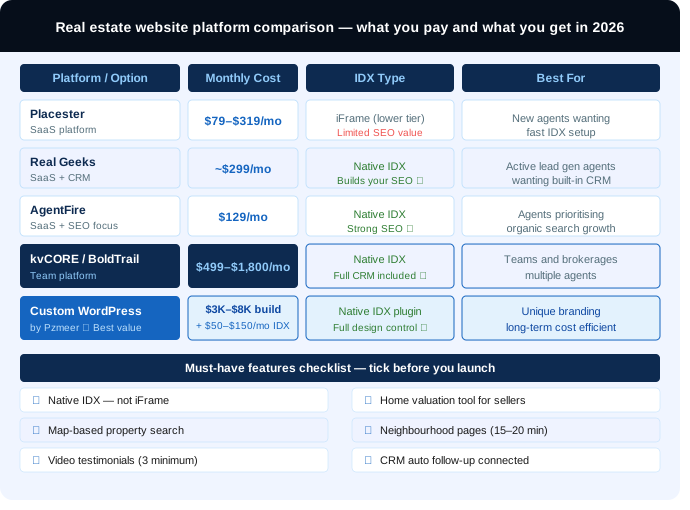
The main real estate website platforms with current 2026 pricing: Placester: $79–$319/month, Real Geeks: ~$299/month plus setup fee, Sierra Interactive: $500–$1,500/month, AgentFire: $129/month, kvCORE/BoldTrail: $499–$1,800/month for teams, BoomTown: $1,000/month for larger brokerages.
Here’s the full cost breakdown across all website types:
| Website Type | Monthly Cost | Best For |
|---|---|---|
|
Template SaaS platform (Placester, Real Geeks) |
$79–$299/month |
New agents wanting fast IDX setup |
|
Mid-range IDX platform (AgentFire, Sierra) |
$129–$500/month |
Growing agents with active lead gen |
|
Custom WordPress + IDX plugin |
$50–$150/month (IDX) + build cost |
Agents wanting full design control |
|
Custom professional build |
$3,000–$8,000 one-time + IDX fees |
Established agents wanting unique branding |
|
Team/brokerage platform |
$499–$1,800/month |
$499–$1,800/month |
The honest cost note: The IDX plugin costs $39–$150/month in perpetuity, and that line item rarely shows up in “WordPress is cheaper than SaaS” comparisons. Budget for it before you commit.
Why Pzmeer offers outstanding value for US agents: At Pzmeer, we build professional, custom real estate websites at 40–60% less than US-based agencies. If you’re looking for a custom-designed WordPress real estate site with professional branding, neighbourhood pages, IDX integration guidance, mobile optimisation, and local SEO setup — without the ongoing SaaS subscription fees of the major platforms — we build exactly that.
Every project includes custom design, domain setup, SSL, WordPress configuration, Google Search Console submission, and social media banners as standard.
Common Real Estate Website Mistakes to Avoid
Using the brokerage website as your primary online presence. When you leave the brokerage, every lead you captured and every Google ranking you built leaves with you. Always maintain your own independent website.
iFrame IDX instead of native IDX. As covered earlier — iFrame IDX builds the vendor’s domain authority, not yours. Native IDX builds yours. The difference compounds over years.
No home valuation offer for sellers. The seller funnel is typically higher-value than the buyer funnel (larger commissions, shorter timelines). If your site has no home valuation tool, you are missing the most direct path to listing leads.
Generic headshot and bio. A specific and detailed About page is one of the features most reliably correlated with improved conversion rate. “Passionate about real estate” helps nobody. Specific market knowledge, transaction volume, and client outcomes do.
No video anywhere on the site. 73% of homeowners are more likely to list with an agent who uses video. If you have no video — not a production, just an iPhone video of you talking about the market — you are at a significant trust disadvantage compared to agents who do.
Not responding to Google reviews. 69% of recent home sellers said they would gladly write a review for their agent if asked. Most agents never ask. Set up an automated review request sent after every closing and watch your review count grow.
Sending paid traffic to the homepage. Any paid advertising — Google, Facebook, Instagram — should go to a dedicated landing page matched to that specific ad’s message, not your general homepage. A landing page that matches the ad converts at 5–10%. The homepage typically converts the same traffic at under 1%.
Frequently Asked Questions
Do real estate agents need their own website or is the brokerage site enough?
Always maintain your own independent website. When you change brokerages — and most agents do at some point — your brokerage website disappears entirely. Every lead you captured, every ranking you built, every content you published on that domain is gone. Your own domain is the only online asset you fully own and control.
What is IDX and do I need it?
IDX (Internet Data Exchange) allows your website to display live MLS listings. For agents working in the US market, it is essentially non-negotiable — without it, visitors have no reason to search properties on your site instead of going to Zillow or Realtor.com. It is the feature that turns a digital brochure into a lead generation tool.
What is the difference between native IDX and iFrame IDX?
Native IDX hosts listing data on your own domain, building your site’s SEO authority with every listing page. iFrame IDX displays listing data from a vendor’s domain within a frame on your site, giving you none of the SEO value. For long-term organic search performance, native IDX is significantly better.
How long does it take to build a real estate agent website?
A custom-designed WordPress real estate site typically takes 4–8 weeks from kickoff to launch. SaaS platforms like Real Geeks or Placester can be configured in 1–2 weeks because the templates and IDX are pre-built. The time investment is front-loaded — once the site is live, it works for you without ongoing effort.
Should I build on WordPress or use a real estate-specific platform?
Both have genuine trade-offs. Real estate SaaS platforms (Real Geeks, AgentFire, kvCORE) bundle IDX, lead capture, and CRM in one system — faster to set up, higher monthly cost, less design flexibility. WordPress gives you more design control and typically lower ongoing costs, but requires separate IDX integration and more technical configuration upfront. For agents prioritising speed and simplicity, a SaaS platform. For agents prioritising unique branding and long-term cost efficiency, WordPress.
How do I get my real estate website to rank on Google?
The most effective actions are: native IDX integration (so listing pages build your domain authority), neighbourhood pages with locally specific content, a Google Business Profile fully optimised and kept current, regular market update blog posts answering local questions, and fast mobile load speed. SEO for real estate is a long game — expect 3–6 months before organic rankings become a meaningful lead source.
What is a realistic conversion rate for a real estate website?
The average real estate agent website converts at less than 2%. Well-built IDX sites with strong lead capture and mobile optimisation convert at significantly higher rates — with IDX sites typically showing 400% longer session times than static agent sites. A realistic goal for a well-optimised site with IDX is 4–8% conversion rate depending on traffic source.
Build a Real Estate Website That Actually Generates Leads
Your real estate website is the foundation of your digital business. It works 24 hours a day, seven days a week — capturing leads from searches at 10pm on a Sunday when you’re unavailable, nurturing them with automated follow-up, and delivering them to your inbox ready for a conversation.
At Pzmeer.com, we build professional real estate websites for US agents — custom design, mobile optimisation, WordPress or platform guidance, local SEO setup, Google Search Console configuration, and complete brand identity — at 40–60% less than US-based agencies charge for the same scope.
- Custom design built around your brand and market
- Mobile-first, fast-loading build
- Neighbourhood pages with local SEO from day one
- IDX integration guidance and setup
- Home valuation lead capture page
- Separate buyer and seller landing pages
- Google Business Profile setup and optimisation
- Domain, SSL, and hosting configuration
- Social media banners included
Pzmeer is a full-service web design and digital marketing agency helping real estate agents and small businesses across the USA build professional websites that generate consistent leads. Our services include custom web design, WordPress development, local SEO, GoHighLevel setup, and digital marketing.